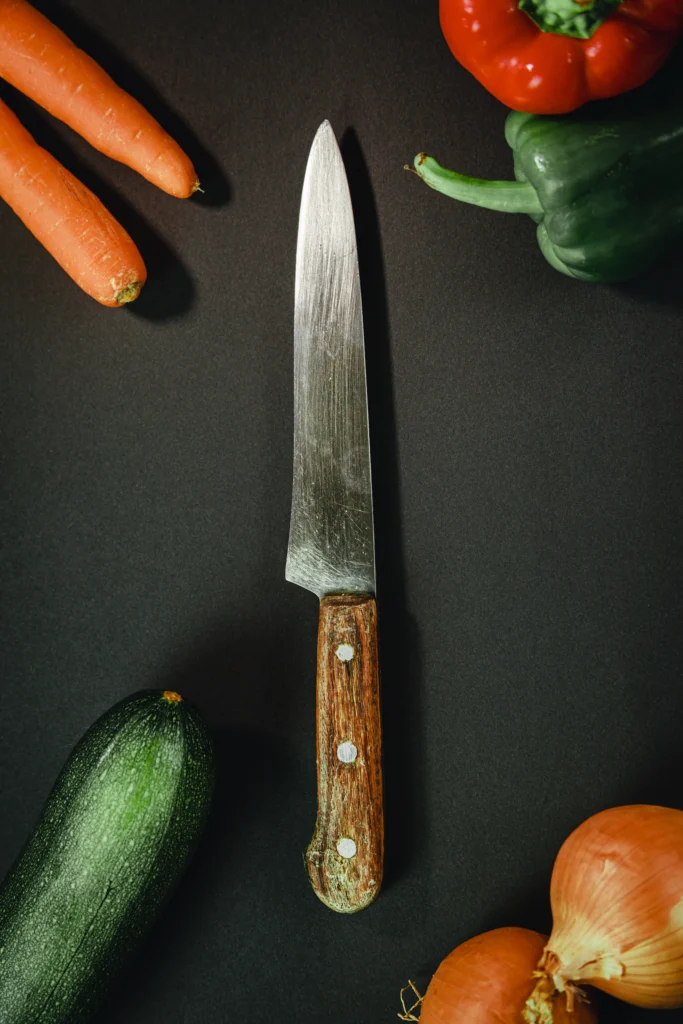
Quick answer: after every use, wash a Damascus kitchen knife by hand, dry it straight away and store it safely. Cut on wood or soft plastic boards, never glass or stone. Wipe the blade during long prep with acidic foods like tomatoes, citrus and onions. Hone lightly every few uses and sharpen on a whetstone a few times a year. If the pattern fades after years of use, it can be brought back by re-etching, ideally by the maker.
A hand-forged Damascus kitchen knife is a tool you will use every day for years. Our main Damascus and carbon steel care guide covers the basics, including rust removal and oiling. This article focuses on the kitchen: the small daily habits that keep a Damascus chef knife sharp, beautiful and rust-free.
The 60-second routine after every use
- Rinse the blade under warm water as soon as you finish cutting. Do not leave it on the board or in the sink.
- Wash with a soft sponge and a drop of washing-up liquid, wiping from the spine towards the edge.
- Dry immediately with a tea towel, including the area where the blade meets the handle.
- Oil occasionally: if you will not use the knife for a few days, or you live somewhere humid, wipe on a thin film of food-safe mineral or camellia oil.
- Put it away in a block, on a magnetic strip or in its knife bag.
Best and worst cutting boards
| Board | Kind to the edge? | Notes |
|---|---|---|
| End-grain wood (maple, walnut, cherry) | Best | The fibres part and close around the edge. Oil the board monthly. |
| Edge-grain wood | Very good | Cheaper and lighter than end grain. |
| Soft plastic or rubber | Good | Easy to sanitise; replace when deeply scored. |
| Bamboo | Fair | Harder than it looks and contains silica; dulls edges faster. |
| Glass, marble, slate, granite, ceramic plates | Worst | Will chip and dull any edge within a few cuts. Use only for serving. |
Foods that stain and how to handle them
Most Damascus kitchen knives are made from high-carbon steels, which react with acids and sulphur compounds. You may see grey or blue tints after cutting:
- Tomatoes, citrus fruit, apples and pineapple
- Onions, garlic and shallots
- Raw meat and fish, especially if left on the blade
- Vinegar-based foods such as pickles
This is normal and harmless, and it is the start of a patina. To keep the blade even and bright, wipe it with a damp cloth every few minutes during long prep and wash it as soon as you finish. Read our guide to patina vs rust to understand the difference between harmless tints and rust.
Honing vs sharpening
- Honing realigns the edge, which bends slightly with use. A few light strokes on a ceramic honing rod every few uses keep the knife cutting well. Ceramic is gentler on hard Damascus blades than a ridged steel.
- Sharpening removes metal to create a new edge. Do it on a whetstone when honing no longer brings the edge back, typically every two to six months for a home cook. Kitchen knives are usually sharpened at about 15 to 20 degrees per side.
Avoid pull-through and electric sharpeners on Damascus blades: they remove a lot of steel, can scratch the pattern and often create an uneven edge.
Storage that protects the edge
- Knife block: safe and convenient; slide knives in on their spine, not their edge.
- Magnetic strip: shows off the Damascus pattern; place the spine on the magnet first and lift off by rolling, to avoid scraping.
- Knife bag or roll: best for travelling and for drawers, as long as the knives go in dry. See our knife roll and bag guide.
- Never loose in a drawer, where edges chip and fingers get cut.
Restoring a faded Damascus pattern
The contrast in Damascus comes from acid etching, which darkens one steel more than the other. Years of washing, sharpening and polishing gradually lighten it. Signs that a blade needs re-etching are a pattern that is hard to see in normal light, or a bright band along the edge after sharpening, which is normal.
- Best option: return it to the maker or a professional knife maker, who can clean, re-etch and neutralise the blade safely.
- Home options: some owners re-etch with diluted ferric chloride or darken the pattern with strong coffee. These need care, protective equipment and correct neutralising, and handles must be protected. If you are unsure, ask the maker first.
Seven mistakes to avoid
- Putting the knife in the dishwasher.
- Leaving it wet in the sink or on the draining board.
- Cutting on glass, stone or plates.
- Scraping food off the board with the edge; turn the knife over and use the spine.
- Twisting or prying the blade through hard squash or frozen food.
- Chopping bones: use a cleaver for that, as explained in our meat cleaver guide.
- Storing it loose in a drawer.
Damascus chef knife sets from our workshop
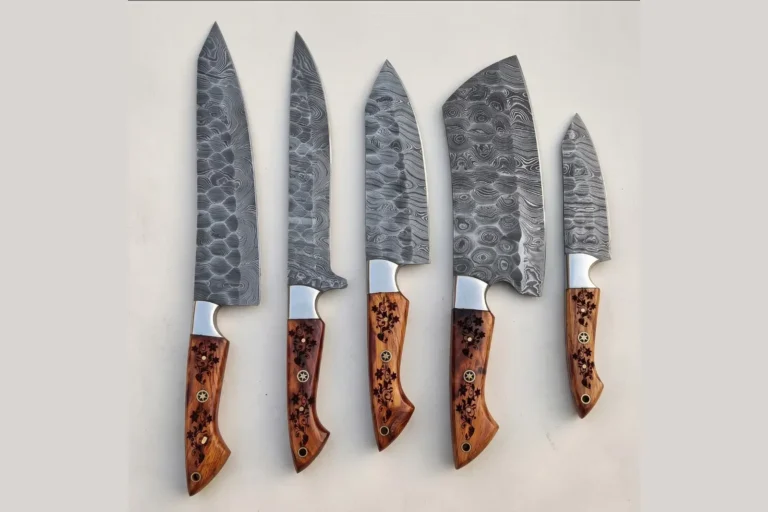
- 5-Pieces Damascus Steel & Wooden Handles Chef Knife set: five hand-forged Damascus steel kitchen knives with engraved wooden handles, in a leather knife bag.
- 6-Piece Damascus Steel Blades and Wooden Handles chef Knife Set: six hand-forged Damascus steel kitchen knives with riveted wooden handles, in a leather knife bag.
The 5-piece Damascus set with engraved handles covers everyday cooking, while the 6-piece Damascus set adds an extra size for keen cooks. Browse all chef knife sets.
Frequently asked questions
Can Damascus kitchen knives go in the dishwasher?
No. Heat, detergent and long exposure to water can cause rust, dull the edge and damage the handle. Always wash by hand and dry straight away.
What is the best cutting board for a Damascus knife?
An end-grain wooden board is the kindest to the edge, followed by edge-grain wood and soft plastic. Avoid glass, stone, ceramic and very hard bamboo boards.
Why does my Damascus knife turn grey after cutting onions?
Onions, tomatoes and other acidic or sulphur-rich foods react with high-carbon steel and leave a grey or blue tint. It is harmless; wipe the blade during prep to keep it even.
How often should I sharpen a Damascus kitchen knife?
Hone it lightly every few uses and sharpen it on a whetstone every two to six months, depending on how much you cook.
Can a faded Damascus pattern be restored?
Yes. The pattern can be brought back by re-etching the blade. It is safest to have this done by the maker or a professional.