Quick answer: patina is a thin, stable, dark layer (grey, blue, brown or black) that forms on carbon steel as it reacts with food and air. It is smooth, does not rub off as orange dust, and actually helps protect the blade. Rust is orange or red-brown, rough or flaky, and eats into the steel if left. Keep the patina; remove rust promptly with oil and a gentle abrasive, then dry and oil the blade.
Many people buy their first carbon steel knife, slice a tomato or an onion, and panic when the blade turns grey-blue within minutes. Relax: that is the knife doing exactly what carbon steel does. Professional chefs in Paris, London and New York, and outdoorsmen everywhere, wear those colours with pride. The trick is knowing the difference between a healthy patina and harmful rust.
What patina is, and why it is good
Carbon steel contains very little chromium, so its surface reacts readily with acids, sulphur compounds in food, moisture and oxygen. The first reactions form a thin layer of stable, dark iron oxides. This layer is the patina. It is tightly bonded to the steel and slows down further reactions, so a well-patinated blade is more resistant to rust than a freshly polished one.
A patina also reduces the metallic smell or taste that new carbon blades can give to acidic foods such as onions and apples. Its colours depend on what you cut: raw meat and fish often leave blue and purple, onions grey, and acidic fruit yellow-brown tints.
Patina or rust: how to tell
| Patina | Rust | |
|---|---|---|
| Colour | Grey, blue, purple, bronze, dark brown or black | Orange, red or reddish brown |
| Texture | Smooth, part of the surface | Rough, raised, powdery or flaky |
| Paper towel test | Little or nothing comes off | Leaves orange-brown marks |
| Spread | Even or in patterns where food touched | Spots, often where water sat or near the handle |
| Effect | Protects the steel | Pits and weakens the steel |
| What to do | Leave it | Remove it promptly |
The simplest check is to wipe the spot with a little oil on a paper towel. If the towel turns orange, it is rust.
How to force a patina
Some owners prefer to create an even patina at the start rather than wait for a blotchy one. This is common with carbon steel kitchen knives and bushcraft knives.
- Degrease the blade with warm soapy water or a little rubbing alcohol, then dry it. Any fingerprints will show in the finish.
- Choose an acid:
- Mustard: dab or brush it on for patterns; leave for 30 minutes to a few hours.
- Warm white vinegar: wrap the blade in vinegar-soaked kitchen paper for an even grey, checking every 15 to 30 minutes.
- Strong hot coffee: dip the blade for a dark brown-black tone over an hour or more.
- Keep acid off the handle, especially wood, and keep it away from the edge if you want, as it can lightly dull a very fine edge.
- Rinse, dry thoroughly and oil. Repeat for a deeper colour.
- Strop or lightly hone the edge afterwards.
Avoid forcing patina on Damascus blades unless you know what you are doing: Damascus is already acid-etched to show its pattern, and further etching changes the look. Our Damascus buyer’s guide explains how that etching works.
How to remove rust safely
- Light surface rust: put a few drops of oil on the blade and rub with a pencil eraser, a wine cork or a fine (0000) steel wool pad. Wipe and repeat.
- Stubborn spots: a paste of baking soda and water, rubbed gently with a cloth, lifts rust without scratching much. Products containing oxalic acid work fast but also strip the patina.
- Pitting: deep rust that has left holes needs sanding or regrinding. On a valuable knife, ask the maker.
- Afterwards: wash, dry completely and apply a thin film of oil.
Avoid coarse sandpaper, wire brushes and power tools: they leave deep scratches that rust even faster. Our full care guide for Damascus and carbon steel knives covers this in more detail.
Preventing rust in the first place
- Wipe the blade between cuts when working with acidic or salty food.
- Wash by hand and dry immediately. Never use a dishwasher and never leave a carbon knife to soak.
- Apply a thin film of food-safe mineral oil or camellia oil before storing.
- Do not store knives in a wet sheath, bag or drawer. Leather traps moisture.
- In humid climates and coastal homes, oil more often and store with a silica gel pack.
Carbon steel knives that wear a patina well
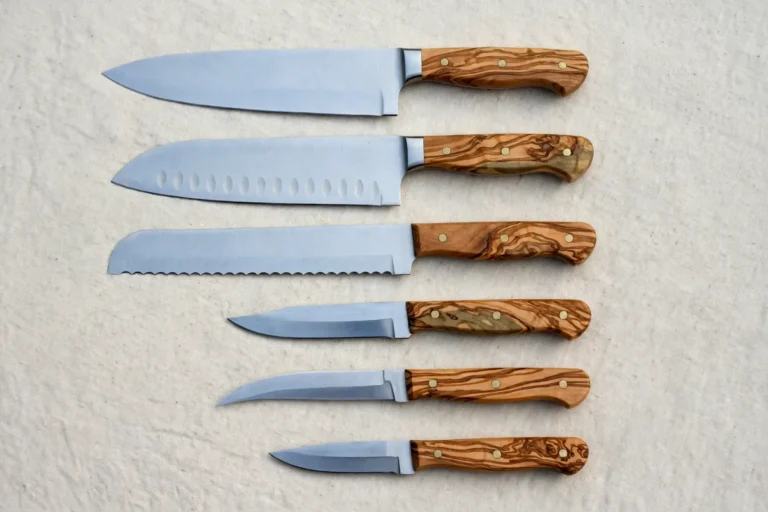
In the kitchen, a carbon steel set develops character fast. The 6-piece carbon steel chef knife set with walnut handles covers everyday cooking, with knives that get very sharp and are quick to touch up on a whetstone; it comes with a leather knife bag. Outdoors, the Shadow Ridge Tracker Knife is a 4 inch (10 cm) carbon steel camp knife with a riveted wooden handle, 8 inches (20 cm) overall, that will build a working patina trip by trip.
- 6-Pieces Carbon steel Blades and Walnut wood Handles chef Set: six carbon steel kitchen knives, wooden handles, leather knife bag.
- Shadow Ridge Tracker Knife: carbon steel tracker knife with a leather sheath.
Browse all chef knife sets or tracker knives.
Frequently asked questions
Is patina on a knife bad?
No. A patina is a stable, protective layer that helps prevent rust on carbon steel. It is purely cosmetic and does not affect sharpness or food safety.
How do I know if my knife is rusting or just patina?
Wipe it with an oiled paper towel. Rust leaves orange-brown marks and feels rough; patina stays put and feels smooth.
Is it safe to cut food with a patinated knife?
Yes. Patina is safe and is found on carbon steel knives in professional kitchens around the world. Remove any orange rust before cutting food.
Can I remove a patina?
Yes. Metal polish or an oxalic acid cleaner will take a blade back to bright steel, but it will be more prone to rust until a new patina forms.
What oil should I use on a carbon steel kitchen knife?
Use a food-safe oil such as mineral oil or camellia oil. Avoid vegetable oils, which can turn sticky and rancid over time.