Quick answer: “scimitar” is a European umbrella word for the curved, single-edged swords of the Middle East and North Africa. The shamshir is the Persian version: a slim, deeply curved blade made for drawing cuts from horseback. The Ottoman kilij is broader, with a widened tip. The Zulfiqar is the famous sword of Ali ibn Abi Talib, traditionally shown with a split, two-pointed tip; today “Zulfiqar-style” swords are inspired by that tradition.
For centuries, curved swords from Persia, the Ottoman Empire, the Arab world and India fascinated European travellers, artists and collectors. They gave them a single name, the scimitar, but behind that word sits a rich family of distinct swords, each with its own shape and story.
“Scimitar”: where the word comes from
“Scimitar” entered English in the 16th century, via Italian and French. Its exact origin is uncertain; some link it to the Persian shamshir. Europeans used it for almost any curved, single-edged sword from the East, from Persian shamshirs to Turkish kilijs and North African sabres. Today, when people say scimitar, they usually mean a sabre with a pronounced curve and a blade that may widen towards the tip.
The Persian shamshir
In Persian, shamshir simply means “sword”. The classic shamshir developed in Persia (Iran) and became famous under the Safavid dynasty from the 16th century. It has a slender, strongly curved blade without a widened tip, a simple crossguard, and a handle that often ends in a pommel angled like a pistol grip.
That shape is designed for slicing, drawing cuts, especially from horseback: the curve lets the edge slide along the target rather than stopping on impact. Fine shamshirs were often made from Persian crucible steel, the “watered steel” that gave rise to the legend of Damascus blades.
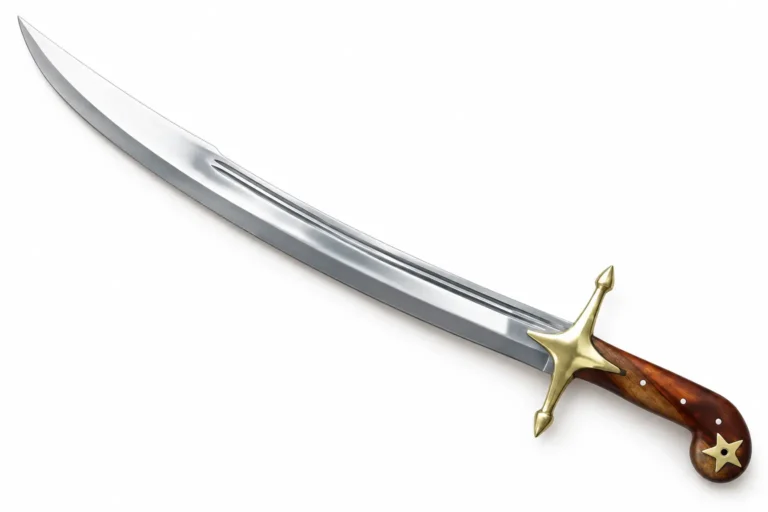
Our Shamshir Sword follows this classic outline, with a 28 inch (71 cm) curved carbon steel blade and a rosewood handle, 34 inches (86 cm) overall.
The Ottoman kilij and other relatives
- Kilij (Turkish): broader and usually less curved along most of its length, with a sharp bend and a widened, often double-edged last section called the yelman. This shifts weight forward for powerful cuts.
- Talwar (Indian subcontinent): a moderately curved sabre with a characteristic disc-shaped pommel, widely used in Mughal India.
- Nimcha and saif: curved swords of North Africa and Arabia.
All of them belong to the broad family Europeans called scimitars.
The Zulfiqar
The Zulfiqar (also written Dhu al-Fiqar or Zulfikar) is the legendary sword associated with the Prophet Muhammad and given to his cousin and son-in-law Ali ibn Abi Talib. It holds deep meaning in Islamic history, especially in Shia tradition, and appears in calligraphy, flags and art across the Muslim world.
In art the Zulfiqar is usually shown with a forked, two-pointed tip, though historians still discuss how the original looked. Modern swords sold as “Zulfiqar” are inspired by this heritage rather than replicas of a single surviving sword. Our Zulfiqar Sword is a Zulfiqar-style curved sword with a 30 inch (76 cm) carbon steel blade, a brass guard and a rosewood handle, 36 inches (91 cm) overall.
Side-by-side comparison
| Shamshir | Kilij | Zulfiqar | |
|---|---|---|---|
| Origin | Persia (Iran) | Ottoman Turkey | Arabia, early Islamic era |
| Curve | Deep and even | Moderate, sharper towards the tip | Shown both curved and straight in art |
| Blade | Slim, no widened tip | Broad, widened tip (yelman) | Often shown with a forked tip |
| Best known for | Elegant slicing cuts from horseback | Powerful cuts | Its religious and historical meaning |
Curved swords from our workshop
- Scimitar Sword: a curved Damascus steel scimitar with a 28 in (71 cm) blade and a decorated wooden handle, 34 in (86 cm) overall.
- Shamshir Sword: a classic shamshir with a 28 in (71 cm) carbon steel blade and a rosewood handle, 34 in (86 cm) overall.
- Zulfiqar Sword: a Zulfiqar-style sword with a 30 in (76 cm) carbon steel blade, brass guard and rosewood handle, 36 in (91 cm) overall.
All three are hand-forged, sharpened and supplied with a leather scabbard; unsharpened display versions and special scabbards can be made on request. The Damascus scimitar is the showpiece of the three, with a pattern-welded blade. See every Islamic sword in the collection, read about functional swords vs wall hangers, and look after carbon steel blades with our sword care routine, which works for any carbon steel sword.
Curved swords are regulated in some countries. In the UK, for example, sales and imports of curved swords with blades of 50 cm (about 20 in) or more are restricted, with limited exemptions. Please check your local laws before ordering.
Frequently asked questions
Is a shamshir a scimitar?
Yes. “Scimitar” is a broad European term for curved Middle Eastern swords, and the Persian shamshir is one of the best-known types.
What is the difference between a shamshir and a kilij?
A shamshir has a slim, evenly and deeply curved blade without a widened tip. A kilij is broader, with its curve concentrated towards a widened tip called the yelman.
What is the Zulfiqar sword?
The Zulfiqar is the sword associated with the Prophet Muhammad and Ali ibn Abi Talib. It is traditionally depicted with a forked tip and is an important symbol in Islamic history and art.
Why are Middle Eastern swords curved?
A curved blade slices with a drawing motion, which is very effective for cavalry: the edge slides through the target instead of stopping on impact.
Are your curved swords sharpened?
Yes. They come sharpened with a leather scabbard. Unsharpened display versions are available on request.