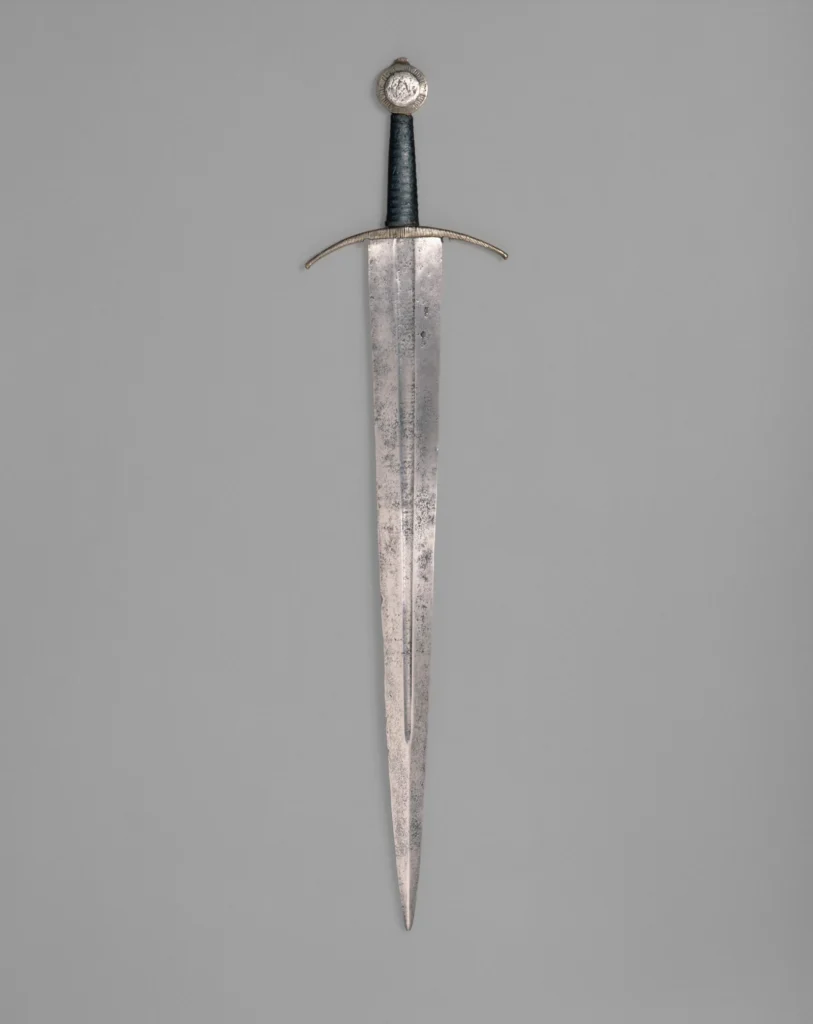
Quick answer: a functional sword is made from a suitable carbon or spring steel that has been properly heat-treated, has a handle and guard that are solidly fixed to the blade, is balanced so it feels lively in the hand, and holds a real edge. A wall hanger is built only to look good: often brittle stainless steel, an unsharpened edge, a handle held on by a thin threaded rod, and a weight and balance that feel wrong. Ask the maker about steel, heat treatment, weight and how the handle is attached before you buy.
Search for a medieval sword and you will find prices from a few dollars to several thousand. Some are built for cutting practice and historical reenactment, others only to hang above a fireplace. Both have their place, but a decorative sword used for cutting can break, and a broken blade is dangerous. Here is how to tell them apart.
What “functional” really means
Different buyers use the word differently, so be clear about what you plan to do:
- Display: the sword hangs on a wall or sits on a stand. Looks are everything.
- Handling and forms: you want to swing it, practise forms and feel how it moves, without hitting anything.
- Test cutting: cutting water bottles, pool noodles or rolled tatami mats. The blade must be sharp, well heat-treated and securely assembled.
- Sparring: fighting another person, for example in HEMA (historical European martial arts). This needs a blunt, specially designed sparring sword, not a sharp one.
“Functional” usually means the third category: a sharp sword that is safe to cut with.
The seven-point checklist
- Steel: carbon or spring steels are preferred for working swords because they flex and return rather than snap. Decorative swords are often made from stainless steel grades that are fine for knives but can be brittle at sword length.
- Heat treatment: the steel must be hardened and tempered. Ask the seller; a genuine maker will tell you.
- Handle construction: the hilt should be solidly attached, with no rattle or movement. Ask how the blade is fixed to the handle and pommel. A thin threaded rod welded to the blade is a warning sign.
- Balance: a well-made one-handed sword usually balances a few inches (roughly 8 to 15 cm) in front of the guard and feels lighter than it weighs. A sword that is very tip-heavy is tiring and hard to control.
- Weight: real swords are lighter than many people think (see the table below). A sword that is much heavier than historical examples is often poorly designed.
- Edge: a functional sword is sharpened with a proper bevel. Wall hangers are usually blunt or have a decorative “edge” that will not cut.
- The maker: can you talk to them? A workshop that forges its own blades can answer questions about steel, sharpening and use.
Typical weights and lengths
| Type | Typical overall length | Typical weight |
|---|---|---|
| One-handed arming sword | 30–38 in (76–97 cm) | 2.2–3.3 lb (1.0–1.5 kg) |
| Longsword | 42–48 in (107–122 cm) | 2.6–3.7 lb (1.2–1.7 kg) |
| Katana | 38–42 in (97–107 cm) | 2.2–3 lb (1.0–1.4 kg) |
| Sabre and scimitar | 33–38 in (84–97 cm) | 1.8–3 lb (0.8–1.4 kg) |
These are general ranges based on historical and modern examples; individual swords vary.
When a display sword is the right choice
There is nothing wrong with buying a sword simply because it is beautiful. Display swords make great centrepieces for a study, a games room or a collection of historical pieces, and an unsharpened blade is safer in a home with children or in a shop or restaurant. Some countries and cities also make an unsharpened blade easier to own or transport. If display is your goal, choose a piece that is still well made so it lasts.
Our swords
Every sword from our workshop in Wazirabad is hand-forged, comes sharpened, and is supplied with a leather scabbard. If you would rather have a display piece, we can make it unsharpened on request, and a special scabbard can also be made to order.
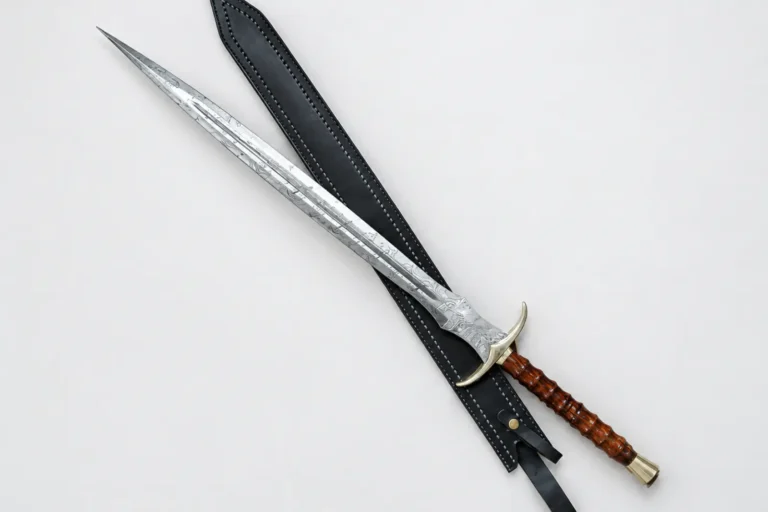
- Medieval Sword: a 30 in (76 cm) Damascus steel blade with a crossguard and carved wooden handle, 38 in (97 cm) overall.
- Single hand Double-Edged Sword: a double-edged one-handed sword with a 24 in (61 cm) black powder-coated carbon steel blade and a micarta handle, 30 in (76 cm) overall.
The Damascus medieval sword is the classic knightly silhouette, with a pattern-welded blade that also looks spectacular on display. The single-hand double-edged sword is shorter and handier, and its powder-coated carbon steel needs less care against rust. Browse every medieval sword or see the full sword collection. If you are new to Damascus, our Damascus steel buyer’s guide explains how the pattern is made.
Sword laws differ between countries, states and cities, especially for carrying in public and for curved blades. Please check your local laws before ordering, and always transport a sword in its scabbard, inside a case or bag.
Frequently asked questions
What is a wall hanger sword?
A wall hanger is a sword made for decoration rather than use. It often has a blunt edge, brittle steel and a weakly attached handle, and it can break if used for cutting.
What does battle ready mean?
Sellers use “battle ready” to mean a sword with a heat-treated blade, a securely assembled hilt and a sharpened edge that can safely cut practice targets. It is a marketing term, so ask about the steel and construction.
How heavy is a real medieval sword?
Most one-handed medieval swords weighed roughly 2.2 to 3.3 lb (1 to 1.5 kg). Even two-handed longswords were usually under 4 lb (1.8 kg).
Can I order a sword unsharpened?
Yes. Our swords come sharpened as standard, but we can make an unsharpened display version on request.
Is Damascus steel good for a sword?
Well-forged Damascus combines steels into a strong, flexible blade with a unique pattern. Like carbon steel, it needs to be kept dry and lightly oiled.