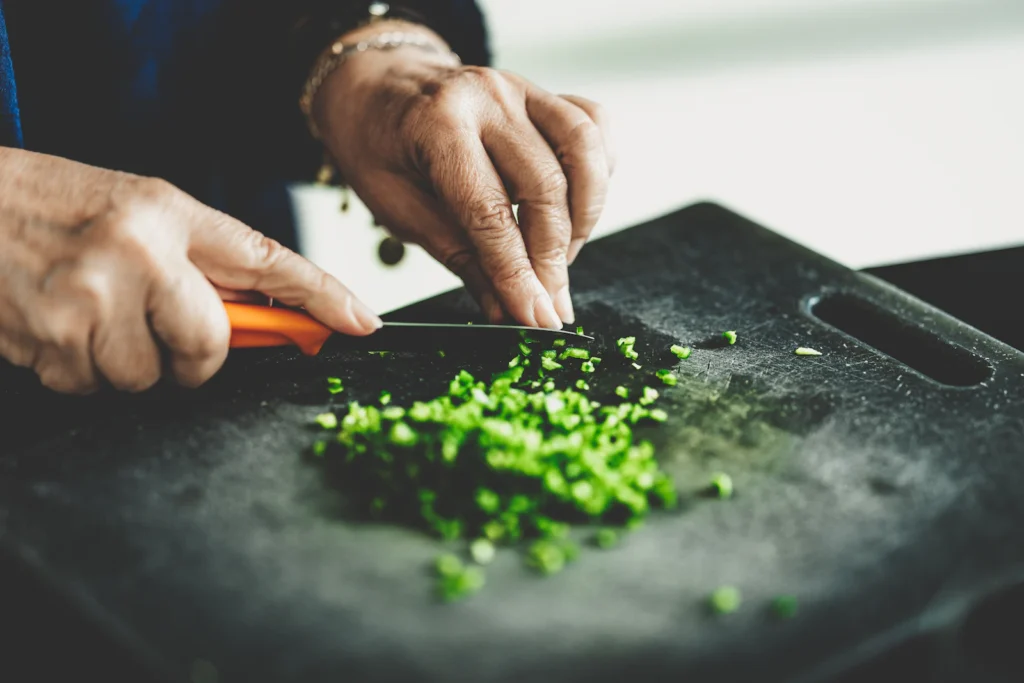
Quick answer: an ulu is a crescent-shaped knife with the handle centred above the blade, traditionally used by Inuit, Yupik and Iñupiat women across Alaska, northern Canada and Greenland. Because your hand sits directly over the edge, you cut by rocking the blade or pushing straight down, which gives a lot of control and power with little effort. In the kitchen it is excellent for herbs, pizza, salads, vegetables, nuts and slicing meat.
The history of the ulu
The ulu (pronounced “OO-loo”) has been used in the Arctic for thousands of years. The word means “woman’s knife” in Inuktitut, and it was traditionally the essential tool of women in Inuit, Yupik and Iñupiat communities. It was used for skinning and cleaning seals and fish, cutting and scraping hides for clothing, trimming snow blocks, and preparing food. Early blades were made of ground slate, later of copper and then of steel, with handles of bone, antler, ivory or wood.
Ulus are still made and used in Alaska, Nunavut and Greenland today, and they have become popular in kitchens far beyond the Arctic.
Why the shape works
- Your hand is directly over the edge, so downward force goes straight into the cut, and your wrist stays in a natural position. Many people with weaker grip or wrist pain find an ulu easier than a chef’s knife.
- The curved edge rocks, so you can mince and chop quickly without lifting the blade.
- There is no tip to catch or stab, which makes it a forgiving knife to use.
How to use an ulu in the kitchen
- Herbs and garlic: pile them on the board, place the ulu on top and rock it back and forth, gathering the herbs back into a pile with the blade.
- Pizza and flatbreads: press down and rock across the pizza. It cuts through crust and toppings without dragging the cheese, better than many wheel cutters.
- Salads: chop leaves and vegetables right in a wooden bowl. Traditional ulu bowls are curved to match the blade.
- Vegetables: slice onions, peppers and courgettes (zucchini) with a push-down-and-rock motion.
- Meat: slice cooked meat thinly, or cut raw meat into strips for stir-fries.
- Nuts and chocolate: rock to chop to any size you like.
Always keep your free hand flat and away from the edge, and work on a wooden or plastic board.
Ulu vs mezzaluna vs chef’s knife
| Ulu | Mezzaluna | Chef’s knife | |
|---|---|---|---|
| Shape | Crescent blade, one central handle | Crescent blade, a handle at each end | Long straight blade, handle at one end |
| Hands needed | One | Two | One |
| Best at | Mincing, pizza, slicing, chopping in a bowl | Mincing herbs | Everything, especially precise slicing |
| Learning curve | Very easy | Very easy | Takes practice |
| Origin | Arctic (Inuit, Yupik, Iñupiat) | Italy | Europe and Japan |
An ulu does not replace a chef’s knife, but it is a brilliant second knife. Our chef knife set guide explains which knives cover everything else.
Sharpening and care
- Wash by hand and dry straight away; never use the dishwasher, especially with a wooden handle.
- Sharpening: lay the bevel on a flat whetstone and rock the blade along the stone so every part of the curve makes contact, the same technique explained in our guide to sharpening curved blades. Check whether your ulu is bevelled on one side or both before you start.
- Handle: oil a wooden handle occasionally to keep it sealed; see our handle materials guide.
- Storage: keep it in its bag or on a stand so the edge is protected.
Our rocking knife
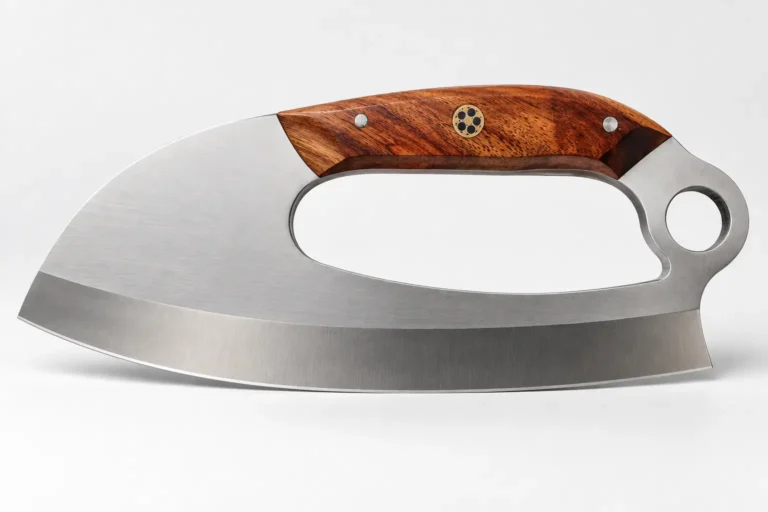
- Viking Ulu Rocking Knife: a stainless steel ulu-style rocking knife with a riveted wooden handle, for herbs, pizza and chopping. Supplied with a leather bag.
- 5-Pieces Damascus Steel Blades & Micarta Handles Chef knife set: a five-piece hand-forged Damascus steel chef knife set with micarta handles, in a leather knife bag, to cover the rest of your cooking.
The Viking Ulu Rocking Knife is stainless steel, so it is easy to care for, and it makes short work of a pizza night. Browse it alongside our cleavers and specialist knives.
Frequently asked questions
What is an ulu knife used for?
Traditionally for skinning, cleaning fish, cutting hides and preparing food in the Arctic. In modern kitchens, for chopping herbs, cutting pizza, slicing vegetables and meat, and chopping salads in a bowl.
Where does the ulu come from?
The ulu comes from the Arctic and has been used for thousands of years by Inuit, Yupik and Iñupiat peoples in Alaska, northern Canada and Greenland.
Is an ulu better than a mezzaluna?
An ulu needs only one hand and handles more tasks, such as slicing and cutting pizza. A mezzaluna uses two hands and is mainly for mincing herbs.
Is an ulu good for people with weak wrists?
Many people find it easier because the handle sits over the blade and the wrist stays straight, so less grip strength is needed. Everyone is different, so try one if you can.
How do you sharpen an ulu?
Rock the curved edge along a flat whetstone at a consistent angle so the whole curve touches the stone, then remove the burr on a strop.