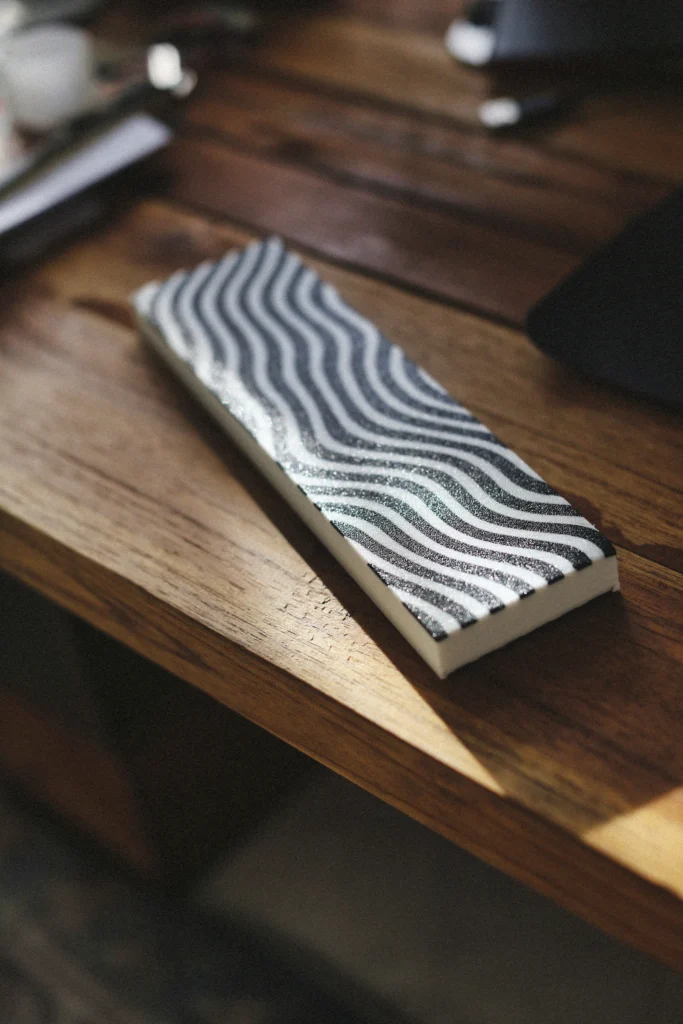
Quick answer: to sharpen a curved blade, work in short sections and lift or rotate the handle as you go so the part of the edge touching the stone is always at the same angle. Use a flat whetstone for outward curves such as a kukri belly. For inward curves, such as the inside of a karambit or a gut hook, use a round or tapered ceramic rod, or the rounded edge of a stone. Finish by stropping on leather.
Most sharpening guides assume a straight edge that you can push across a stone in one long stroke. Curved blades break that rule. Push a kukri straight across a stone and you will sharpen the middle and miss the tip and the belly; try it with a karambit and the stone never touches the inside curve at all. The fix is simple once you understand it.
Why curved blades are different
A sharp edge is two flat bevels meeting at a consistent angle. On a straight knife, holding one angle is easy. On a curve, the edge changes direction along its length, so if you hold the knife still, the angle changes as the contact point moves. The solution is to move the knife with the curve, lifting the handle slightly or sweeping in an arc, so the bit of edge on the stone is always square to your stroke.
There are two kinds of curve:
- Convex (outward) curves: a kukri belly, a skinner, or the tip of most hunting knives. A flat stone works well.
- Concave (inward) curves: the inside edge of a karambit, a gut hook, and the “waist” of some kukris. A flat stone cannot reach them; a round rod can.
What you need
- A two-sided whetstone, such as 1000 and 3000 or 1000 and 6000 grit, or a diamond plate for harder steels.
- A round or tapered ceramic rod for inward curves.
- A leather strop, with or without polishing compound.
- A permanent marker: colour the edge bevel and you can see exactly where the stone is touching.
- Water or honing oil, depending on your stone, and a cloth.
Our knife care and sharpening guide covers the basics of choosing stones, finding your angle and testing sharpness. This guide builds on it for curved shapes.
How to sharpen a kukri
A kukri edge sweeps forward into a deep belly, and its blade is long and heavy, so it is often easier to hold the kukri still and move a stone or puck over it.
- Mark the bevel with a marker along the whole edge.
- Find the angle. Kukris are working choppers, so a slightly wider angle of about 20 to 25 degrees per side gives a durable edge.
- Divide the edge into sections: near the handle, the waist, the belly and the tip.
- Sharpen each section with short strokes on the stone, lifting the handle as you move towards the belly so the curve stays flat on the stone. Check the marker: if it is removed evenly, your angle is right.
- Raise a burr, a tiny rough lip you can feel on the opposite side, along the whole length, then switch sides.
- Move to the finer grit and repeat with lighter pressure.
- Strop both sides on leather, pulling the edge away from the strop, to remove the burr.
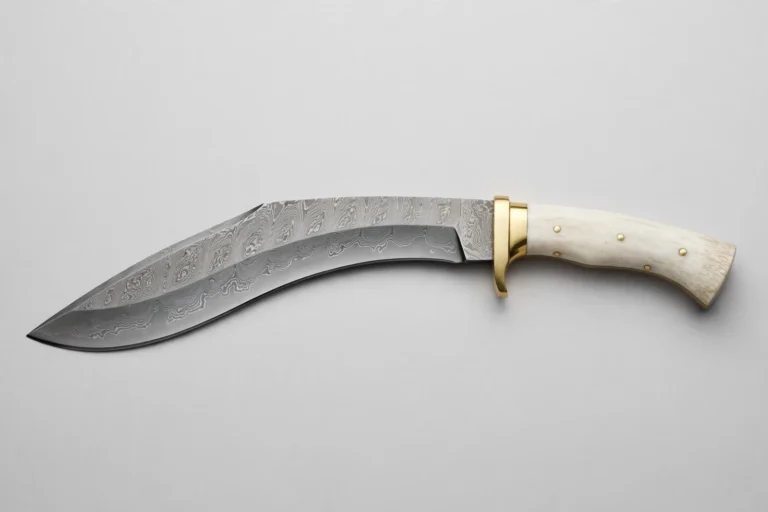
The process is the same whatever the steel, but Damascus and carbon blades such as the Wolf-Crescent Kukri (a 9 inch, 23 cm Damascus blade) sharpen quickly; harder steels take more strokes. After sharpening, wipe off the metal dust and give carbon or Damascus a light coat of oil.
In the field, a small round or “puck” stone is easier than a bench stone: hold the kukri edge up, keep your fingers behind the edge, and move the stone in small circles along the bevel.
How to sharpen a karambit
A karambit’s claw-shaped blade has its edge on the inside of the curve, which is the hardest shape to sharpen.
- Use a round ceramic rod whose curve is tighter than the blade’s curve, so it can touch every part of the edge.
- Hold the rod still and lay the bevel against it at your angle, about 15 to 20 degrees.
- Draw the blade along and across the rod in one sweeping motion from the heel to the tip, rotating your wrist to follow the claw.
- Use light pressure and count strokes, the same number each side.
- Strop by wrapping leather around a dowel or rod, so it follows the inside curve.
If your karambit also has an edge on the outside of the curve, treat that like a convex blade on a flat stone. Take extra care with the point: karambit tips are fine and easy to round off. A Damascus karambit such as the Everest Karambit Knife, with a 4 inch (10 cm) claw blade and a white bone handle, rewards this light, patient approach.
Sharpening a gut hook
A gut hook is a small, tight inward curve. Use a thin tapered rod: slide it into the hook until it touches both sides, match the angle of the hook’s bevel, and pull it out a few times while turning slightly. Gut hooks are usually sharpened from one side only, so check which side has the bevel before you start.
Common mistakes
- Using a flat stone on an inside curve: you only touch two points and grind flats into the edge.
- Holding the knife still on a curve: the belly and tip end up blunt.
- Too much pressure: on thin points, it rolls the edge. Let the stone do the work.
- Skipping the burr: if you switch sides too early, the edge never fully forms.
- Forgetting to clean and oil carbon and Damascus blades afterwards.
Not sure whether a kukri or another chopper is right for you? Compare them in kukri vs machete vs hatchet, or browse our karambits and kukris. Please check your local laws before buying or carrying a karambit.
Frequently asked questions
What angle should I sharpen a kukri at?
Around 20 to 25 degrees per side gives a strong edge for chopping. A finer angle cuts more easily but is more likely to chip on hard wood.
Can you sharpen a karambit on a flat whetstone?
Only the outside curve. The inside edge of a karambit needs a round rod, a tapered sharpener or the rounded edge of a stone.
Can I use an electric or pull-through sharpener on a curved blade?
It is not recommended. Pull-through sharpeners only fit straight edges and can damage the curve, the tip and the edge geometry.
How often should I sharpen a kukri?
Strop or touch it up after each trip, and fully sharpen it when stropping no longer brings back the edge. Heavy chopping blunts any blade faster.
How do I know when the edge is sharp?
The edge should reflect no light when you look straight down on it, and it should slice cleanly through paper along the whole curve, including the belly and tip.