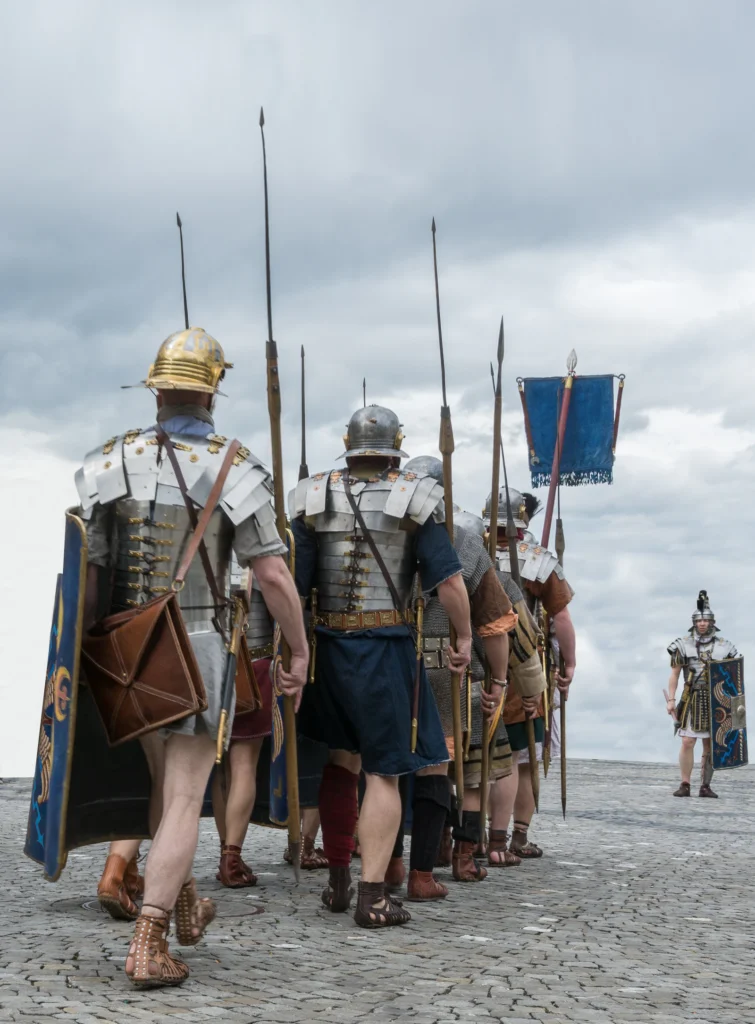
Quick answer: the gladius was the short, double-edged sword of the Roman legionary. Historians usually group it into three main types: the early Hispaniensis (blade roughly 24 to 27 in, 60 to 68 cm), the Mainz type with a waisted blade and long point (about 20 to 22 in, 50 to 55 cm), and the shorter Pompeii type with straight edges (about 18 to 20 in, 45 to 50 cm). Used together with the large scutum shield, it was built for quick thrusts and cuts in close formation.
For more than four centuries the gladius helped carry Roman power from Spain to Syria and from North Africa to Hadrian’s Wall in northern England. It is one of the most recognisable swords in history and a favourite of reenactors, history teachers and film fans. Here is what we know about it, and how modern gladius-style swords compare.
What a gladius is
Gladius is simply the Latin word for sword, but historians use it for the short, straight, double-edged sword carried by Roman infantry from roughly the 3rd century BC to the 3rd century AD. Typical features:
- A straight, double-edged blade with a strong point.
- A rounded handguard, a ribbed grip shaped for the fingers, and a large rounded pommel, often of wood or bone.
- A scabbard worn on the right side by ordinary legionaries, so the sword could be drawn without catching the shield.
The three main types
| Type | Approximate period | Blade length | Shape |
|---|---|---|---|
| Gladius Hispaniensis | c. 3rd century BC to 1st century BC | 24–27 in (60–68 cm) | Slightly waisted, long point; adopted from Iberian swords |
| Mainz | Late 1st century BC to 1st century AD | 20–22 in (50–55 cm) | Waisted blade with a long, tapering point |
| Pompeii | 1st century AD onwards | 18–20 in (45–50 cm) | Parallel edges, short triangular point |
These ranges come from surviving finds and vary between examples. The Mainz type is named after finds near Mainz in Germany, and the Pompeii type after swords found at Pompeii, buried by Vesuvius in AD 79.
How legionaries used it
Roman soldiers fought in close order behind the tall, curved scutum shield. The short gladius was ideal in that crowded space: a soldier could punch with the shield and then strike with short thrusts to the body from behind it, keeping himself covered. Roman writers such as Vegetius praised the thrust, which needed only a short movement. The gladius was also sharp along both edges, and finds and texts show it could deliver powerful cuts as well.
Gladius vs spatha
From the 2nd and 3rd centuries AD, the gladius was gradually replaced by the spatha, a longer straight sword with a blade of roughly 30 to 39 in (75 to 100 cm). Originally used by cavalry, it gave more reach for fighting on horseback and in looser formations. The spatha is an ancestor of the early medieval swords of Europe. Our guide to functional swords vs wall hangers covers what to look for in any straight sword.
Where to see Roman swords
- British Museum, London: including the decorated “Sword of Tiberius” scabbard, a Mainz-type gladius.
- Vindolanda and the Roman Army Museum, near Hadrian’s Wall, Northumberland.
- Leibniz Centre for Archaeology (LEIZA), Mainz, Germany.
- Naples National Archaeological Museum and the site of Pompeii, Italy.
- The Metropolitan Museum of Art, New York, for Roman arms and armour.
Choosing a gladius-style sword today
Modern swords sold as “gladius” or “gladiator” swords range from accurate replicas to loosely inspired designs. Decide what matters to you:
- Historical accuracy: look for a specific type (Mainz, Pompeii or Hispaniensis) and blade length to match.
- Display: a striking blade and handle may matter more than exact proportions.
- Cutting practice: choose a well-made, sharpened sword with a properly heat-treated blade and a secure handle.
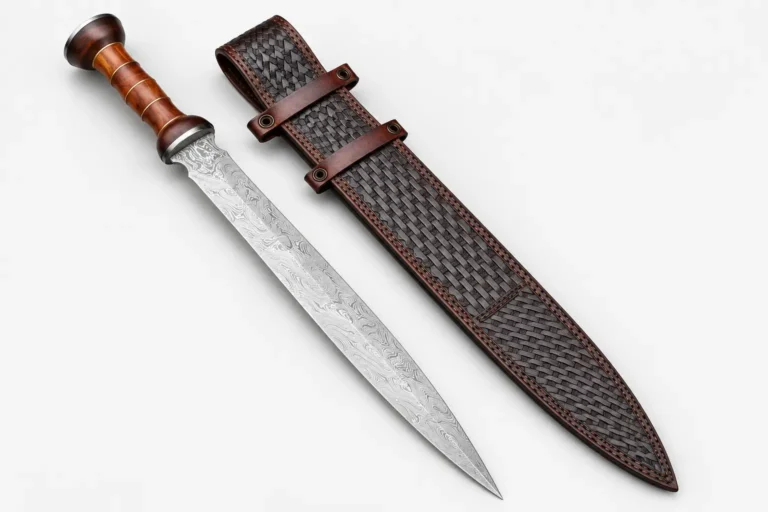
- Gladiator Sword: a Roman gladius-style Damascus steel sword with a 26 in (66 cm) blade and a wooden handle, 34 in (86 cm) overall. Its blade is at the long end of the range, closest to the early Hispaniensis.
- Single hand Double-Edged Sword: a double-edged one-handed sword with a 24 in (61 cm) black powder-coated carbon steel blade and a micarta handle, 30 in (76 cm) overall, a practical, low-maintenance short sword.
The Gladiator Sword is the piece for anyone who loves the Roman look, with the added beauty of a pattern-welded blade; read about Damascus in our Damascus buyer’s guide. Both swords are sharpened and come with a leather scabbard; a display version or special scabbard can be made on request. Browse the full sword collection. Please check your local laws before ordering a sword.
Frequently asked questions
How long was a Roman gladius?
Blade lengths ranged from about 18 in (45 cm) on the Pompeii type to about 27 in (68 cm) on the early Hispaniensis, with overall lengths of roughly 25 to 33 in (64 to 85 cm).
Was the gladius used for stabbing or slashing?
Both. Roman tactics favoured short thrusts from behind the shield, but the double-edged blade was also used for cutting.
What is the difference between a gladius and a spatha?
The spatha is longer, with a blade of about 30 to 39 in (75 to 100 cm). It began as a cavalry sword and replaced the gladius from the 2nd and 3rd centuries AD.
Did gladiators use the gladius?
Some did. Gladiators fought with many weapons depending on their type, and the name gladiator comes from gladius, but not every gladiator used one.
Why did Roman soldiers wear the sword on the right?
Wearing the gladius on the right let a soldier draw it without moving his shield, which was held on the left. Centurions often wore theirs on the left.