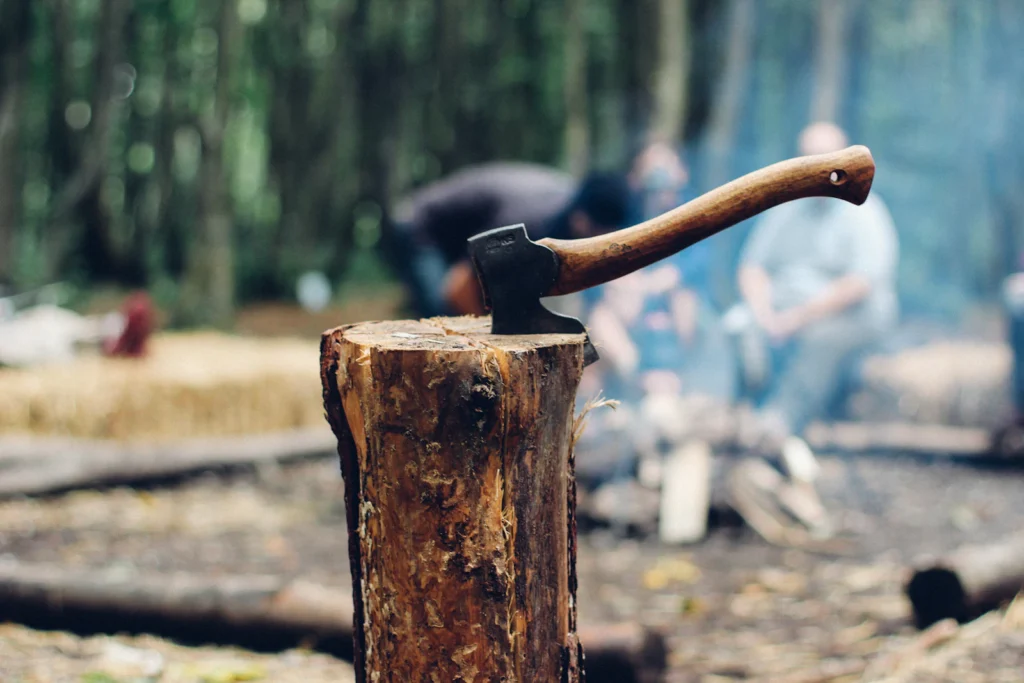
Quick answer: choose a machete for clearing long grass, brambles and thin brush, because its long, light blade sweeps through soft growth. Choose a hatchet for splitting and chopping firewood, because its weight sits in a wedge-shaped head. Choose a kukri if you want one tool that does a bit of both: its forward-curved blade puts weight near the tip for strong chops, yet it is still a knife you can carve and prepare kindling with.
Ask on any camping forum which chopper to bring and you will start an argument. The honest answer is that each tool is shaped for a different kind of work. Once you know where the weight sits and how long the edge is, the choice becomes simple.
Kukri vs machete vs hatchet: side-by-side comparison
| Machete | Kukri | Hatchet | |
|---|---|---|---|
| Typical blade | 18–24 in (46–61 cm), thin and long | 9–12 in (23–30 cm), thick, curved forward | 3–4 in (8–10 cm) bit on a 12–14 in (30–36 cm) handle |
| Where the weight sits | Spread along the blade | Towards the curve near the tip | In the head |
| Best at | Grass, vines, brambles, thin saplings | Limbing, chopping branches, general camp work | Splitting logs, chopping thicker wood |
| Weaker at | Hard, thick wood | Very long grass, big logs | Fine carving, clearing brush |
| Can it carve and cut food? | Awkwardly | Yes, near the handle | Only roughly |
| Carry | Long sheath on a pack or belt | Belt sheath | Head cover, on a pack |
The machete: reach and speed
A machete is a long, relatively thin blade designed for fast, sweeping cuts. The length gives reach, so you can clear a path without bending close to the brush, and the thin edge slices green vegetation easily. In the American South, the tropics, or an overgrown allotment or garden in the UK, a machete clears ground faster than anything else.
The trade-off is hard wood. A thin machete tends to bounce off seasoned logs. That is why heavier “chopper” machetes exist: thicker steel and a broader blade add weight for branches. Our Tactical Chopper Machete is this kind of tool, with a 24 inch (61 cm) carbon steel blade, a micarta handle that grips in wet weather, 30 inches (76 cm) overall, and a leather sheath.
The hatchet: splitting power
A hatchet concentrates its mass in a heavy head behind a short edge. The wedge shape forces wood fibres apart, which is why a hatchet or small axe splits firewood that would jam a knife. If your trips revolve around a wood stove, a fire pit or a cabin, a hatchet earns its place.
Its weaknesses are reach and versatility. A short hatchet is risky when swung at brush close to your legs, and it is not a cutting tool for rope, food or feather sticks. Most hatchet users still carry a knife.
The kukri: the all-rounder
The kukri is the traditional blade of Nepal, famous worldwide as the tool and weapon of the Gurkha regiments of the British and Indian armies. Its distinctive forward bend moves the blade’s weight and its widest point towards the tip, so each swing hits with more force than a straight knife of the same length. Near the handle the edge is narrower and finer, so you can carve, notch and slice.
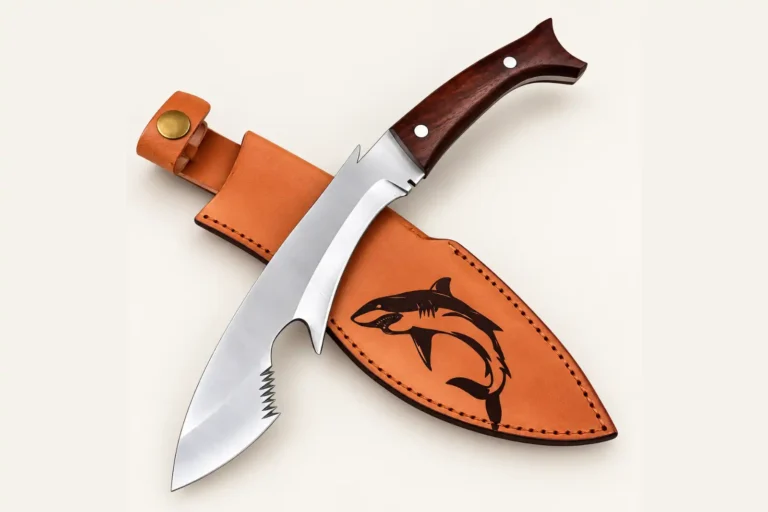
That makes the kukri the favourite of many bushcrafters who want to carry one blade: chop limbs and kindling, clear a few brambles, and then make camp. A larger kukri such as the Shark Kukri Knife has an 11 inch (28 cm) carbon steel blade, 16 inches (41 cm) overall, with a rosewood handle and a leather sheath. For lighter work and lower maintenance, the Crimson-Peak Kukri Knife has a 9 inch (23 cm) stainless steel blade that copes better with damp weather, 14 inches (36 cm) overall.
Which one should you buy?
- Clearing trails, a garden or farmland: a machete.
- Car camping with lots of firewood: a hatchet, plus a small knife.
- Backpacking or bushcraft with one chopping tool: a kukri. It saves weight and does most jobs well.
- Wet climates such as the Pacific Northwest, Scotland or Scandinavia: consider stainless steel or keep carbon steel well oiled.
Not sure about steel? Carbon steel is tough and easy to resharpen but needs drying and oiling; stainless steel resists rust with less care. Our hunting knife types guide explains where a kukri fits alongside bowies, trackers and skinners, and the care guide shows how to keep carbon steel rust-free.
Safe chopping and the law
- Check that no one is within two arm’s lengths plus the length of the tool.
- Chop with the wood on a log or stump, never against the ground, and keep your legs out of the line of the swing.
- Keep the edge sharp: a blunt blade is more likely to glance off.
- Always sheath the blade when carrying it.
Laws on owning and carrying large blades differ. In the UK, for example, carrying a fixed blade in public without a good reason is an offence, and some machete and “zombie-style” designs are banned. Several EU countries and US states also have carry rules. Please check your local laws and keep large blades at home, at camp or on your land.
Browse all kukri knives to compare blade lengths, steels and handles.
Frequently asked questions
Is a kukri better than a machete?
A kukri chops wood better because its weight sits forward in a thick, curved blade. A machete is better for clearing grass and thin brush because it is longer and lighter. For general camping, a kukri is the more versatile choice.
Can a kukri replace a hatchet?
For limbing branches, kindling and small logs, yes. For splitting a lot of large firewood, a hatchet or axe is still easier and safer.
What size kukri is best for camping?
A blade of about 9 to 11 inches (23 to 28 cm) is the sweet spot: long enough to chop well, short enough to carry on a belt and control for carving.
Why is a kukri curved?
The forward curve puts weight and the widest part of the blade towards the tip, which adds chopping power, while the narrower section near the handle stays useful for finer cutting.
Is carbon steel or stainless steel better for a kukri?
Carbon steel is tough and easy to sharpen in the field but must be dried and oiled. Stainless steel needs much less care in wet weather. Both work well for camp chopping.