Quick answer: the best knife for field dressing a deer is a fixed-blade knife with a 3 to 4 inch (7.5 to 10 cm) drop-point blade, a handle that stays grippy when wet, and a sheath you can wear on your belt. A gut hook makes opening the belly faster and keeps you from cutting into the stomach. A longer 5 inch (13 cm) blade helps with bigger animals like elk or red deer, but a short blade gives more control for the delicate cuts.
Whether you hunt whitetails in Pennsylvania, stalk roe and red deer in the Scottish Highlands or hunt wild boar and deer in Germany or Sweden, the first job after a clean shot is the same: get the insides out quickly so the meat cools. In the UK this is called the gralloch; in the US it is simply field dressing. A good knife makes it cleaner, faster and safer.
What size and shape of blade works best?
Most experienced hunters prefer a modest blade. A long knife feels impressive but is clumsy inside a body cavity, where you are often working by feel.
- Blade length: 3 to 4 inches (7.5 to 10 cm) is ideal for whitetail, roe, fallow and mule deer. Around 5 inches (13 cm) suits elk, red deer and moose, where cuts are longer.
- Drop point: the back of the blade slopes down to the tip, so the point is easy to control and less likely to puncture the stomach or intestines.
- A slightly curved belly: a curved edge sweeps through skin and connective tissue, which is what you want for skinning later.
- Fixed blade: no joint to clog with blood and hair, and much easier to clean than a folding knife.
- Grip: your hands will be wet and cold. Bone, antler and textured handles give a secure hold; a finger guard stops your hand sliding onto the edge.
A compact skinner such as the Himalayan Skinner Knife fits the size brief well: a 4 inch (10 cm) Damascus steel blade, 8 inches (20 cm) overall, with a leather sheath so it rides on your belt until you need it.
Do you need a gut hook?
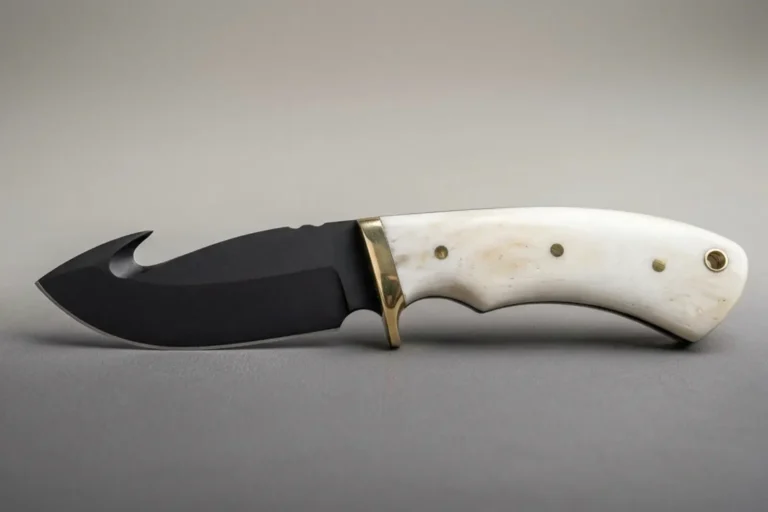
A gut hook is a small, sharpened hook ground into the spine of the blade. You make a short starting cut, slip the hook under the skin and pull it up the belly like a zip. Because the sharp inner edge faces away from the organs, you open the hide without slicing into the stomach, which is the main thing that taints meat in the field.
Gut hooks are not essential, and many hunters manage with a careful plain edge, but they are a real help for beginners, in poor light or when your hands are numb. They also speed up opening the legs for skinning. The GutHuk gut hook skinning knife combines a 4 inch (10 cm) blade with a gut hook on the spine. Its black powder-coated carbon steel resists rust better than bare carbon steel, which matters when the knife goes back in its sheath wet.
What to pack in your field dressing kit
- Your knife, sharpened before the season, plus a small pull-through sharpener or a ceramic rod.
- Long, elbow-length gloves (shoulder-length for bigger animals) and a pair of nitrile gloves.
- A head torch: many deer go down at dusk.
- Paper towels or a small cloth, and a bottle of water to rinse your hands and the knife.
- Zip-lock bags for the heart and liver if you keep them.
- A length of cord to tie a leg back, and a drag strap.
- Your tag, licence or permit. In most US states you must tag the deer before moving it.
- Optional: a small bone saw for the pelvis and breastbone, especially on bigger animals.
How to field dress a deer, step by step
Rules on tagging, carcass transport and disease testing differ by state, country and estate. Check them before the season. Then:
- Make it safe. Approach from behind, confirm the animal is dead, unload your rifle and put on your gloves.
- Position the deer on its back, ideally with the head slightly uphill. Tie a hind leg back or ask a partner to hold it open.
- Free the back passage. Cut carefully around it so it can be pulled through into the body cavity later. Some hunters tie it off with string to keep the meat clean.
- Open the belly. Pinch the skin just in front of the pelvis, make a shallow cut and then use the gut hook, or two fingers under the skin as a guide, to open the belly up to the breastbone. Keep the blade shallow.
- Cut the diaphragm, the sheet of muscle separating the stomach from the chest, around the edge of the rib cage.
- Reach forward and cut the windpipe and gullet as far up the neck as you can reach. Take care: this is blind work and where most cut fingers happen.
- Roll the organs out. Turn the deer on its side and pull the windpipe; the organs should come away in one mass. Cut any remaining connective tissue along the spine.
- Drain and wipe the cavity, then prop it open with a stick to let air in.
Want the basics of the knife types hunters use for each stage, from skinning to quartering? Read our guide to hunting knife types.
After the gutting: cooling and care
Heat is the enemy of good venison. Get the carcass out of the field and into a larder, cold room or shaded spot as soon as you can, and keep flies off it. In warmer early-season weather in the southern US or southern Europe, bags of ice in the cavity help.
Your knife needs attention too. Rinse it in clean water as soon as you are done, dry it fully, and never store it wet in the leather sheath: the leather holds moisture against the steel. At home, wash with warm soapy water, dry, and wipe a thin coat of oil on carbon or Damascus blades. Our knife care and sharpening guide goes through every step.
Knives we make for the job
Every hunting knife from our Wazirabad workshop is hand-forged and supplied with a leather sheath. These three are the best fit for field dressing:
- GutHuk Knife: gut hook, 4 in (10 cm) black powder-coated carbon steel blade, bone handle, 8 in (20 cm) overall.
- Himalayan Skinner knife: 4 in (10 cm) Damascus steel skinner with a wooden handle, 8 in (20 cm) overall.
- Harrier skinner Knife: a slightly longer 5 in (13 cm) D2 tool steel blade with an antler handle, 9.5 in (24 cm) overall, for elk, red deer and bigger game.
If you hunt bigger animals, the Harrier skinner is the better choice for long skinning cuts; for whitetail, roe and fallow, either 4 inch knife is plenty. See every skinning knife in the collection.
Frequently asked questions
What size knife do you need to gut a deer?
A blade of 3 to 4 inches (7.5 to 10 cm) is enough for most deer. It gives you the control you need inside the body cavity. Go up to around 5 inches (13 cm) for elk, red deer and moose.
Is a gut hook knife worth it?
For many hunters, yes. A gut hook opens the belly skin quickly without cutting into the stomach or intestines, which helps keep the meat clean, especially for beginners or in poor light.
Can I use a folding knife to field dress a deer?
You can, but a fixed blade is stronger and much easier to clean, because there is no hinge for blood and hair to collect in.
What is the gralloch?
Gralloch is the traditional UK and Scottish term for removing the internal organs of a deer after the shot, the same job American hunters call field dressing.
How do I stop my hunting knife rusting in the sheath?
Rinse and dry the blade before it goes back in the sheath, oil carbon and Damascus blades after cleaning at home, and store the knife and the leather sheath separately in a dry place between hunts.