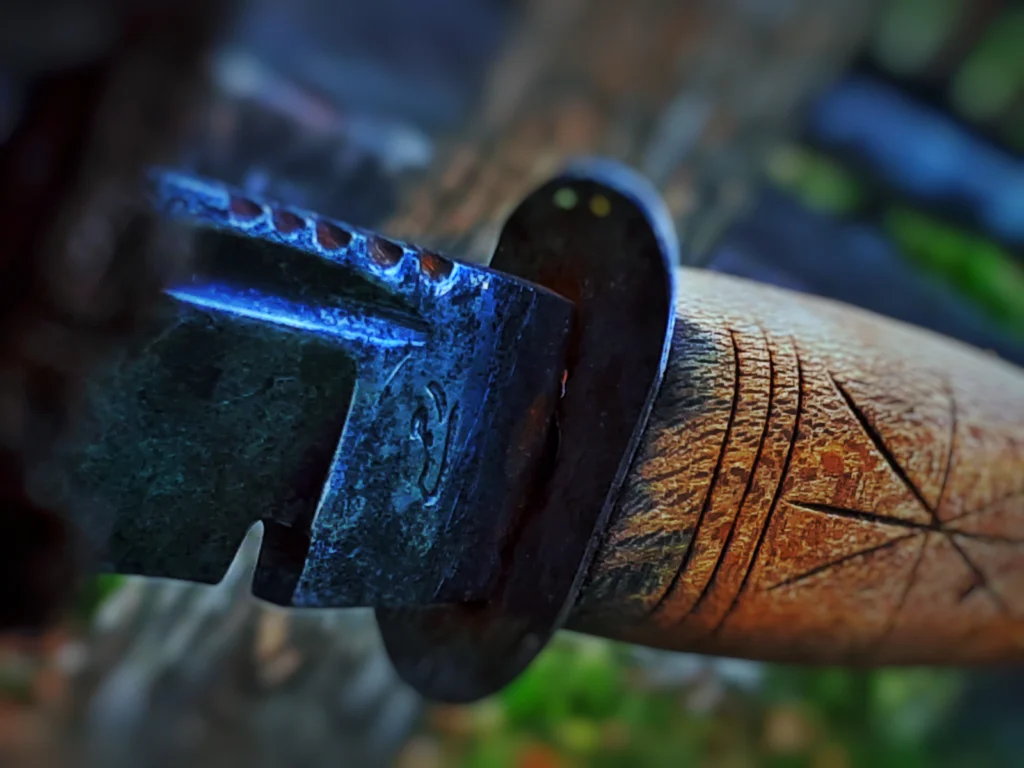
Quick answer: a bowie knife is a large fixed-blade knife, usually with a 6 to 12 inch (15 to 30 cm) blade, a clip point (the top of the blade near the tip is cut away in a concave or straight “clip”), and a crossguard. It is named after the American frontiersman Jim Bowie, who made it famous after the Sandbar Fight of 1827. Today bowies are used as camp knives for chopping, batoning and general outdoor work, and for hunting large game.
The story of the bowie knife
Few knives are as tied to a single person as the bowie. James “Jim” Bowie was a Kentucky-born frontiersman, land speculator and adventurer. In September 1827 he was caught up in a brawl on a sandbar of the Mississippi River near Natchez, later known as the Sandbar Fight. Despite being shot and stabbed, Bowie survived and killed an opponent with a large knife. Newspapers spread the story across the United States, and soon everyone wanted “a Bowie knife”.
Who made the original is still debated. Many accounts credit Jim’s brother Rezin Bowie with the design; others link later versions to the Arkansas blacksmith James Black. Jim Bowie himself died at the Alamo in 1836, which only added to the legend. By the 1840s and 1850s the bowie had become the knife of the American frontier, carried by settlers, trappers, soldiers and gold miners.
Sheffield and the bowie boom
There is a strong British side to the story. In the mid-19th century, cutlers in Sheffield, England, then the world’s leading centre of steel and cutlery, made huge numbers of bowie knives for export to America. Many carried patriotic American slogans etched on the blade. Antique Sheffield bowies are now prized by collectors on both sides of the Atlantic.
Wazirabad, where our workshop is, has a similar story: a town known for generations of blade making. It is often called Pakistan’s City of Cutlery.
What makes a knife a bowie?
- A large blade: typically 6 to 12 inches (15 to 30 cm). Original 19th-century bowies were often big, fighting-sized knives.
- A clip point: the spine drops towards the tip in a “clip”, creating a sharp, controllable point. Some clips have a false edge sharpened on top.
- A crossguard: a metal guard between blade and handle that protects the hand.
- A broad belly: a curved edge good for slicing and skinning.
- A substantial handle, traditionally wood, horn, bone or antler.
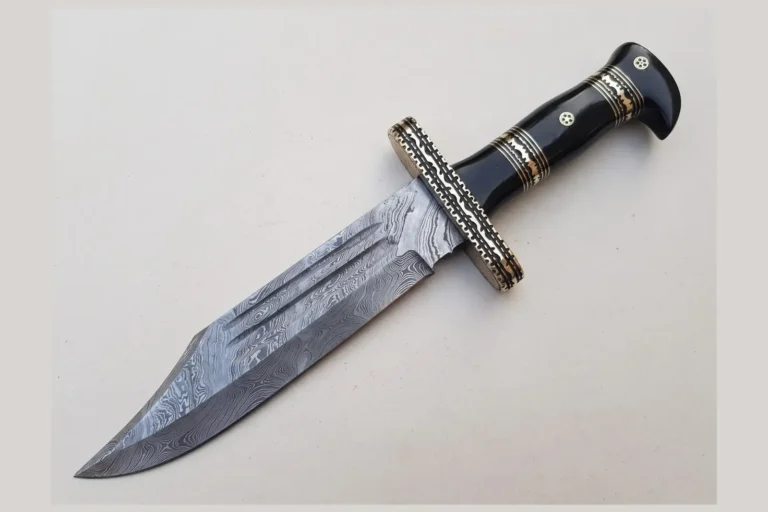
The Woodsman Bowie shows the classic form: a 9 inch (23 cm) clip-point blade in hand-forged Damascus steel, a cow horn handle, and 14 inches (36 cm) overall.
What a bowie knife is good for today
- Camp work: the weight and length make a bowie good for chopping small branches, batoning firewood and clearing light brush.
- Hunting large game: the long belly helps with skinning and quartering elk, red deer or wild boar, though a small skinner is better for detail work. Our field dressing guide explains why.
- General outdoor and ranch use: cutting rope, opening feed bags, and jobs where a small knife is too light.
- Collecting and display: a well-made bowie is a piece of American history, and many owners keep one simply because they love the design.
Where a bowie is less ideal: fine carving and small food prep, where a 4 inch (10 cm) knife is easier. Many campers carry a bowie together with a smaller knife. If you are weighing a bowie against a dedicated chopper, read kukri vs machete vs hatchet.
Choosing a bowie: size, steel and handle
- Size: 7 to 8 inch (18 to 20 cm) blades balance chopping and control; 9 inches (23 cm) and up chops better but is heavier on the belt.
- Steel: Damascus for performance and looks, D2 for edge retention, stainless steel for low care in wet weather. Our knife steel guide compares them.
- Handle: antler, bone and horn are traditional and grippy; wood is warm; micarta is the most weatherproof.
- Sheath: a large knife needs a good sheath. Every bowie we make comes with a leather sheath.
- Woodsman Bowie Knife: 9 in (23 cm) Damascus clip-point blade, cow horn handle, 14 in (36 cm) overall.
- Iron Reign Bowie Knife: 7 in (18 cm) stainless steel blade, natural deer antler handle, 12 in (30 cm) overall. The low-maintenance choice.
The Iron Reign Bowie is the easier everyday companion in rain and wet woods. Browse all bowie knives. Laws on owning and carrying large fixed blades vary, so please check your local laws.
Frequently asked questions
Why is it called a bowie knife?
It is named after Jim Bowie, an American frontiersman who became famous for using a large knife in the Sandbar Fight of 1827 near Natchez on the Mississippi River.
What is a clip point blade?
A clip point has the top of the blade near the tip cut away, either straight or concave, which creates a fine, sharp point. It is the signature feature of the bowie knife.
How long is a bowie knife blade?
Most bowies have blades between 6 and 12 inches (15 and 30 cm). Around 7 to 9 inches (18 to 23 cm) is the most practical range for outdoor use.
Is a bowie knife good for survival and camping?
Yes. A bowie can chop, baton and slice, making it a versatile camp knife. Pair it with a smaller knife for detailed work.
Were bowie knives made in England?
Yes. In the 19th century, Sheffield cutlers made many of the bowie knives sold in America, and antique Sheffield bowies are highly collectable.